EPFO Wage Ceiling Increased to Rs. 25,000: What Employers, Employees and Staffing Companies Need to Do Now
Summary
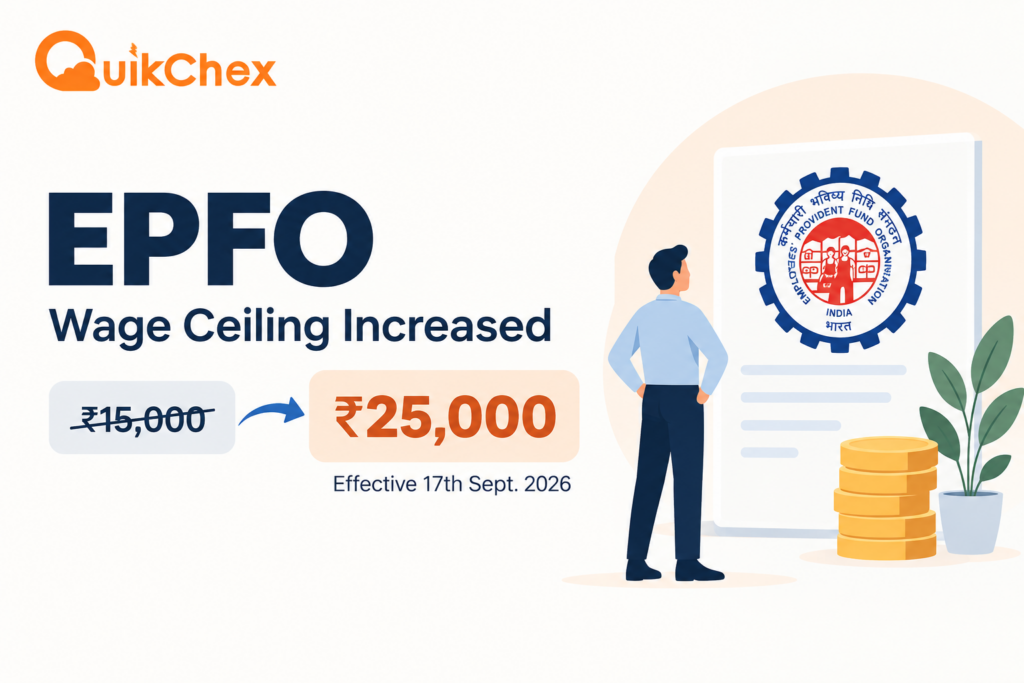
The Government of India has increased the statutory EPFO wage ceiling for mandatory coverage from Rs. 15,000 per month to Rs. 25,000 per month with effect from 17 September 2026.
The change has been notified for Chapter III of the Code on Social Security, 2020. In practical terms, more employees now need to be reviewed for mandatory EPF coverage, while contributions may increase for many employees who were already covered but had PF wages capped at the older Rs. 15,000 ceiling.
For employees, this can mean higher retirement savings, higher pension-linked contributions and broader social security coverage. It can also reduce monthly take-home pay where the employee contribution increases. For employers, it can increase payroll cost and change CTC calculations, so employee masters, wage structures and payroll settings need to be reviewed carefully.
Recruitment and staffing companies have an additional layer to manage because the change can affect employees across several clients, along with principal employer reporting, billing sheets and commercial agreements. The employee-wise impact should be mapped before payroll is changed or revised costs are passed on to a client.
What did the government do?
The Ministry of Labour and Employment issued a Gazette notification dated 17 September 2026. It notifies Rs. 25,000 per month as the wage ceiling for the purposes of Chapter III of the Code on Social Security, 2020, with effect from the date of publication in the Official Gazette.
A separate EPFO press release states that the statutory wage ceiling for mandatory EPFO coverage has been enhanced from Rs. 15,000 to Rs. 25,000 per month with effect from 17 September 2026.
This is not just a number change in payroll. It changes which employees need to be reviewed for PF coverage, the contribution base for some existing members, and the cost assumptions used by employers and staffing companies.
Why did the government increase the EPFO wage ceiling?
The broad policy objective is wider social security coverage. The earlier Rs. 15,000 ceiling left many formal-sector workers outside mandatory coverage when they joined above the threshold as excluded employees. Raising the wage ceiling to Rs. 25,000 brings a larger part of the workforce within the retirement savings, pension and insurance framework.
The EPFO press release also points to higher EPF accumulation and higher pension-linked contributions for employees. It refers to employer incentives under PMVBRY as a possible way to offset part of the additional cost, but only where the employer and employee meet the scheme conditions.
Who is directly impacted?
The revision does not affect one salary band or one type of organisation. Before any cost is calculated, employees and stakeholders should be separated into the following groups, because the action differs for each.
- Employees: Not every employee is affected in the same way, and some are affected for the first time.
- Employees already covered under PF whose PF wage is between Rs. 15,000 and Rs. 25,000 and whose contribution was capped at the earlier ceiling. Their contribution base may increase.
- Employees who were earlier excluded because they joined with PF wages above Rs. 15,000, but whose relevant PF wage is now at or below Rs. 25,000. These employees need to be reviewed for mandatory enrolment under EPF, EPS and EDLI.
- Employees with PF wages above Rs. 25,000. They should not all be treated the same. Some may remain validly excluded, some may already be PF members and must continue, and some may be contributing on actual wages. Their PF history, joining status, wage structure and company policy matter.
- Employers: The exercise is an employee-wise classification, not a percentage uplift across the payroll. The cost of employment, the CTC position and the payroll configuration all need to be settled before the first revised payslip is issued.
- Recruitment and staffing companies: Everything applicable to employers applies here as well, with an added commercial dimension. Deployed staff sit largely in the affected wage band, so the increased contribution has to be reviewed client by client and approved in writing before payroll is processed.
- Principal employers: The exposure is indirect but real. Contractor invoices will move, the cost pass-through position in each agreement needs to be confirmed, and documentary proof of contractor compliance should be obtained for workers deployed on your premises.
Your impact and action plan
Pick your role below. Each one sets out what the revised ceiling actually changes for you, then the steps to work through. Tick items off and assign an owner and a date — progress stays saved on this device, so a part-finished list is still there when you come back.
If you are an employee
What the revision means for your salary, and the four things to check so it lands correctly in your own account.
- If you were already a PF member capped at ₹15,000, your deduction rises because contributions are now computed on your actual PF wage up to ₹25,000. Take-home pay falls by the same amount your EPF balance gains.
- If you were excluded from PF because your wage crossed ₹15,000, and it is at or below ₹25,000, you may be enrolled for the first time and will see a PF deduction on your payslip that was never there before.
- If your employer already contributes on actual wages rather than the capped amount, your own deduction may not change much — but your pension and insurance mapping still needs to be reviewed.
- The money is not lost. The higher deduction goes into your own EPF account and earns interest, and a larger share flows to pension-linked contributions. It qualifies for deduction under Section 80C.
-
Confirm the Universal Account Number is activated and that Aadhaar, PAN and bank details are correctly seeded against it. An inactive or mis-seeded UAN is the most common reason a contribution fails to credit.
-
If you were previously outside PF because your wage crossed ₹15,000, and it is now at or below ₹25,000, you may be brought in for the first time. Submit whatever enrolment and KYC details your employer asks for without delay.
-
Check that the PF wage used matches your basic and dearness allowance, and that the deduction shown is what you expect. Raise anything that looks wrong in the same month rather than later.
-
Both your own contribution and the employer's share should appear. Remember the pension portion will not show as a passbook balance — that is normal.
If you are an employer
What this costs you, who it touches, and the ten steps to work through — in order. The classification steps come first deliberately.
- Three groups need separate treatment. Existing members capped at ₹15,000; employees previously excluded who now fall within ₹25,000; and employees above ₹25,000, who should not all be handled the same way since existing members are not automatically removed from coverage.
- CTC is the decision that cannot wait. Where PF sits inside CTC, the increased employer share has to be either absorbed or restructured — and that needs approval before payroll changes, not after employees see a revised payslip.
- The biggest risk is treating this as a percentage change. Applying a blanket uplift across the payroll hides the employees who were excluded, those on actual-wage contributions, and the edge cases. It has to be an employee-wise classification exercise.
- Some sectors are hit far harder than others. Manufacturing, retail, logistics, BPO and early-stage startups tend to have large populations clustered in exactly the ₹15,000–₹25,000 band, so the aggregate cost lands heavily rather than marginally.
-
Pull everyone whose PF wage sits between ₹15,000 and ₹25,000 and who was being contributed for on the capped amount. This is the group whose contributions rise immediately.
-
Employees kept out of PF because their wage exceeded ₹15,000 may now fall inside the revised limit and need to be reviewed for mandatory enrolment.
-
They should not all be treated the same way. An existing member is not automatically removed from coverage, so this group needs a documented position rather than a blanket rule.
-
Work out the revised employee deduction and employer cost individually, not as an average across the payroll. Totals hide the cases that need attention.
-
One row per employee covering name and ID, current wages, present PF status, existing and revised deductions, and a remarks column for the action required. This sheet becomes the audit trail for everything that follows.
-
Settle whether the increased employer contribution sits inside the existing CTC or on top of it, and get that decision approved, before anything changes in payroll.
-
Run a representative employee from each category through the revised setup and check the output before processing live. Configuration errors are far cheaper to find here.
-
Tell people their deduction is changing, and why, before the revised payslip reaches them. An unexplained drop in take-home pay generates far more queries than an explained one.
-
Name who is responsible for each step and keep a tracker against it, so nothing sits half-done between HR, payroll and finance.
-
Match the impact sheet against what actually processed, and against the challan, before treating the change as closed.
If you run a recruitment or staffing company
Everything in the employer tab applies to you as well. This is what sits on top of it — and the commercial steps need to happen before payroll goes live, not after.
- The cost increase is a commercial event, not just a payroll one. Deployed staff sit largely in the affected wage band, so the additional employer contribution goes straight to either your margin or your client's invoice.
- Every client has to be assessed separately. Billing basis and contract terms differ, so a single organisation-wide position does not work. The review runs client by client, or deployment group by deployment group.
- Approvals have to be documented and obtained in advance. Processing a revised payroll first and raising the billing question afterwards is how these turn into disputes and unrecovered cost.
- Your principal employers will ask for proof. Challans, remittance records and employee-level evidence need to be retained client-wise, because their own compliance exposure depends on yours.
-
Review deployed staff by client or deployment group rather than as one combined payroll, because the commercial treatment differs by contract.
-
Add client name, billing basis and approval status alongside the wage and contribution columns, so the payroll view and the commercial view sit in one place.
-
Identify where the increased employer contribution affects billing rates or the CTC offered to deployed staff, and mark those for approval rather than absorbing them silently.
-
Written approval on the revised cost, obtained in advance, is what prevents a billing dispute later. Verbal agreement at account-manager level is not enough.
-
A single team-level view of which clients are reviewed, approved and processed stops accounts being missed when the work is split across people.
-
Anyone speaking to a client or a candidate should be giving the same answer on cost impact and timing.
-
Deployed staff will hear about the change from several directions. One consistent explanation, issued by you, avoids contradictory messages reaching them from the client site.
-
Check what was processed and what was billed against the approved position, for each client separately.
-
Keep challans, remittance records and employee-level evidence filed by client. Principal employers are entitled to ask for these, and usually will.
If you engage contractors as a principal employer
Where your exposure sits, and the three checks to run. Your risk is for contract labour deployed on your premises, so the work here is oversight rather than payroll.
- Contractor invoices will move. Deployed workers sit largely in the affected band, so expect revised costs — and expect them to arrive whether or not the contract says who absorbs a statutory increase.
- Your contracts decide who pays. Cost pass-through clauses need to be checked now, so the position is settled before the first revised invoice rather than negotiated after it.
- Compliance failure travels upward. If a contractor does not enrol or remit correctly for workers on your premises, the liability can land with you as principal employer, which is why documentary proof matters.
-
Request a written view of which deployed workers are affected and what the revised contribution comes to, rather than waiting for a revised invoice to arrive.
-
Confirm what each contract says about statutory cost increases, so it is clear in advance who absorbs the additional contribution.
-
Check challans, remittance records and employee-level proof for deployed staff. Compliance failure by a contractor can still come back to the principal employer.
How the contribution impact works
The standard employee EPF contribution is 12% of PF wages. The employer contribution is also generally 12%, split between EPS and EPF. Under the usual split used in payroll calculations, 8.33% goes to EPS and 3.67% goes to employer EPF, subject to the applicable scheme rules, ceilings and rounding.
For a capped EPFO wage ceiling of an employee moving from the old Rs. 15,000 to the new EPFO wage ceiling of Rs. 25,000 ceiling, the employee contribution rises from Rs. 1,800 to Rs. 3,000 per month. The employer contribution also rises from Rs. 1,800 to Rs. 3,000 per month. That is an increase of Rs. 1,200 per month on each side before considering EDLI, administrative charges, CTC treatment and other payroll-specific items.
To get a better idea you can use our EPF contribution impact calculator below:
EPF contribution impact calculator
Enter a monthly PF wage to see exactly how the ceiling revision from ₹15,000 to ₹25,000 changes contributions on both sides. Tap any i for what the term covers.
Old ceiling — ₹15,000
New ceiling — ₹25,000
How this is calculated. Contributions apply on PF wage restricted to the ceiling. The employee contributes 12%; the employer's 12% splits into 8.33% to EPS and the balance to EPF, with EPS rounded to the nearest rupee as EPFO does. Figures are indicative, exclude the minimum admin-charge floor, and assume contributions on capped wages. Confirm your own payroll configuration before applying any change.
Edge cases and nuances
A few categories need separate review because the revised ceiling does not answer every payroll question on its own:
- Employees already contributing on actual PF wages may not see the same increase as capped employees. Payroll should still review EPS, EDLI and reporting logic.
- Employees who were excluded earlier because they joined above Rs. 15,000 but are now at or below Rs. 25,000 need special attention. Their enrolment should follow the applicable EPFO instructions and payroll process.
- Employees above Rs. 25,000 should not be automatically removed from PF if they are already members. Existing membership and contribution history matter.
- International workers, apprentices, trainees, consultants and retainers should be reviewed separately. Their treatment can depend on rules that are different from the domestic wage ceiling or on the actual nature of the engagement.
- Part-month joiners and exits may need payroll-specific handling because the notification took effect on 17 September 2026, part-way through the month.
Clarifications employers should watch for
The Gazette establishes the revised ceiling, but employers may still need operational circulars, FAQs or portal guidance on some practical points:
- September 2026 payroll: how the mid-month effective date should be handled where salary has already been processed, including any arrears or true-up treatment.
- Previously excluded employees: the exact enrolment process, effective date and supporting documentation for employees who now fall within the revised ceiling.
- PF wage mapping: how the revised ceiling should be applied to the relevant PF wage base in different payroll structures. Employers should not treat gross salary as a substitute for a proper PF wage review.
- EPS, EDLI and administration: whether any linked ceiling, allocation or system logic needs separate operational changes where payroll systems were hardcoded to the old threshold.
- PMVBRY incentives: the EPFO press release refers to possible employer incentives, but eligibility should be checked against the scheme conditions rather than assumed in payroll cost projections.
Questions employers & employees are asking
The twelve that come up most, answered in plain terms. Filter by what you need, or open them all.
01What exactly is the new EPF wage ceiling?
The mandatory wage ceiling for EPF coverage has been raised from ₹15,000 to ₹25,000 a month, notified by the Ministry of Labour and Employment on 17 September 2026 under Chapter III of the Code on Social Security, 2020. It widens the base on which contributions are computed rather than changing the contribution rates themselves.
02Does everyone earning up to ₹25,000 now have to be covered?
Not automatically. Coverage depends on the PF wage rather than gross salary, on the nature of the engagement, and on whether the person is already a PF member. Someone drawing ₹24,000 gross may have a PF wage well below that once the components are examined, and consultants, retainers and apprentices need separate consideration.
This is why the review has to be done employee by employee against the employee master, not by filtering a payroll report on gross pay.
03What happens to employees earning above ₹25,000?
They are not automatically removed from coverage. An existing PF member generally continues as a member regardless of later wage increases, so the revision does not create an exit route. What changes is the base: contributions for them are computed on the ₹25,000 cap, which is the maximum increase under the new rules.
Employees above the ceiling who were never members are a separate question and should be reviewed case by case with a documented position rather than a blanket rule.
04What about employees we had excluded from PF entirely?
Anyone excluded because their wage exceeded the old ₹15,000 threshold needs to be reviewed. If their PF wage now sits at or below ₹25,000, they may fall within mandatory coverage and require enrolment, UAN generation and KYC for the first time.
This group is the one most often missed, because they do not appear in any existing PF report — they have to be found in the employee master.
05How much more will be deducted from an employee's salary?
Up to ₹1,200 a month. At the old ceiling the employee contributed 12% of ₹15,000, or ₹1,800; at the new ceiling that becomes 12% of ₹25,000, or ₹3,000. Employees whose PF wage sits between the two thresholds see a proportionally smaller increase.
Take-home pay reduces by that amount, but the money is credited to the employee's own EPF account and qualifies for deduction under Section 80C.
06How much does the employer's cost go up?
By the same ₹1,200 a month per affected employee — from ₹1,800 to ₹3,000 — and then a little more once EDLI and administrative charges are added, since those are also computed on the revised wage and are borne entirely by the employer.
Within that ₹3,000, the split changes too: roughly ₹2,083 is diverted to the pension scheme and ₹917 goes to the EPF account, against about ₹1,250 and ₹550 before.
07We already contribute on actual wages. Does this affect us?
The impact on the employee's EPF deduction is limited, because contributions were never restricted to ₹15,000 in the first place. That does not make the change irrelevant, though.
Pension scheme contributions and EDLI are still tied to the statutory ceiling, so the mapping of those components needs to be reviewed and your payroll system's logic updated accordingly. Assuming no action is required is a common and expensive error for these employers.
08Will government incentive schemes offset the additional cost?
Not automatically, and not for everyone. Any offset under an employment-linked incentive scheme depends on meeting that scheme's own eligibility conditions, which cover the type of employee, the timing of enrolment and the employer's own status.
Treat it as a separate verification exercise against the scheme terms rather than as an assumption built into your cost estimate.
09Should we change our payroll configuration straight away?
No. Change the classification first, then the configuration. Identify the affected employees, agree the CTC treatment, test the revised setup on sample cases from each category, and only then process live.
There are also operational points still to be clarified — how a mid-month effective date of 17 September is handled in that month's payroll, and the enrolment route for previously excluded employees among them. Rushing the configuration ahead of those answers usually means reprocessing.
10What should staffing companies be telling their clients?
Give each client a written, client-specific impact sheet rather than a general note. It should show which deployed employees are affected, the revised contribution, the effect on billing or CTC, and what approval is being sought.
Get that approval documented before the revised payroll is processed. Raising it afterwards is how these become billing disputes and unrecovered cost.
11What is the biggest risk in handling this?
Treating it as a payroll percentage change instead of an employee-wise classification exercise. Applying a uniform uplift across the payroll quietly misses the employees who were excluded and now qualify, those already on actual-wage contributions, and every edge case — international workers, apprentices, retainers, part-month joiners and exits.
Those omissions surface later as enrolment defaults and arrears, which cost considerably more to fix than to prevent.
12What is the very first thing we should do?
Run a PF impact audit of your employee master. Classify every employee into the relevant category, calculate the individual impact, and record it in an employee-wise impact sheet with a remarks column for the action required.
That single sheet drives everything that follows — the cost approval, the payroll configuration, the employee communication and the reconciliation after the first processed payroll.
Still unsure where you stand? The answers above are general guidance on the revision, not advice on your specific payroll. Employee classification, CTC treatment and edge cases are best confirmed against your own employee master before anything is changed.