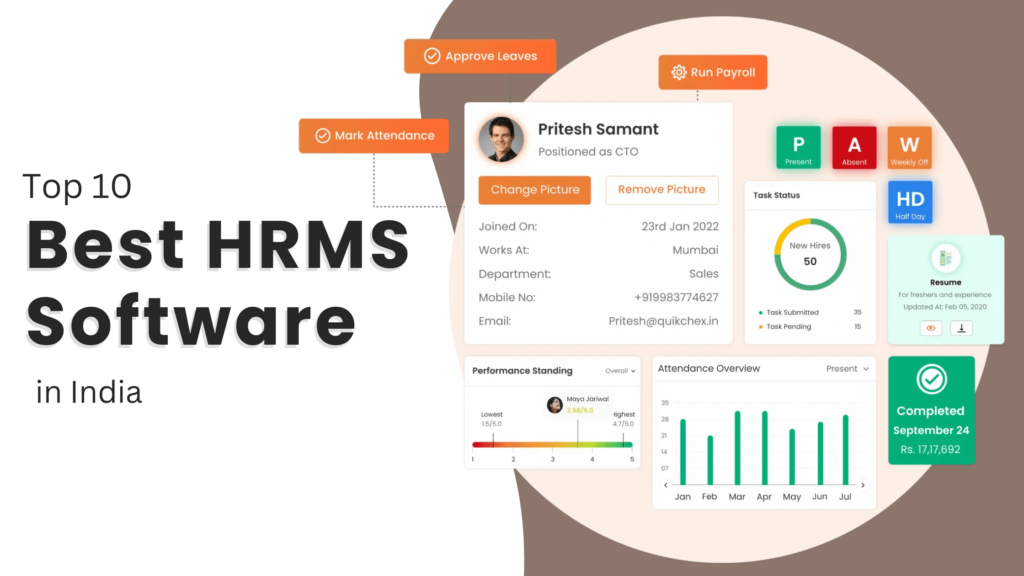
Top 10 Best HRMS Software in India (2026)

Introduction
In 2026, HRMS (Human Resource Management System) software are helping HR departments across India that are facing increasing challenges as they grow.
Organizations need to move quickly, and for increasing number of employees, from onboarding to attendance to payroll, managing performance reviews, looking at analytics and gaining insights, all while being compliant, whether it is for a single or multiple locations.
In this guide, we’ll compare the top ten best HRMS software in India. Familiarize you with overall capabilities and shortcomings and guide you to choose the best HRMS for your company.
What is an HRMS Software?
An HRMS (Human Resource Management System) is software that automates and manages HR procedures, such as employee records, recruitment, attendance monitoring, payroll processing, statutory compliance, performance reviews, and analytics, all from a single dashboard. It helps decrease human errors, accelerates HR cycles, improves compliance, and enhances employee experience.
Importance of HRMS Software in 2026
In 2026, HRMS has become indispensable for Indian businesses because it offers:
- Full statutory compliance with India-specific payroll and labour laws.
- Remote and hybrid workforce management (geo-tagged attendance, mobile apps).
- Scalable payroll automation, especially important with evolving tax rules.
- Employee self-service (ESS) portals that reduce HR workload.
- Data-driven decisions using HR analytics and dashboards.
Evaluating and Choosing the Best HRMS Software (in India)
If you are a seasoned HR professional or just stepping into a role where you need to choose an HRMS (Human Resource Management System) for your team, the evaluation part is key. The software platform should be able handle everything from paying employees to tracking attendance, hiring new staff, and monitoring performance — all in one place. Choosing the right one for your organization is one of the most important decisions you will make, and it does not have to be overwhelming. Keep reading to know what exactly to look for.
Features and Modules
Think of an HRMS as a toolbox — the more relevant tools it has, the more work it can do for you. When evaluating a system, check that it covers these core features, among others to choose the right fit for your organization.
Payroll Automation
Manually calculating salaries, deductions, and bonuses every month is time-consuming and error prone. A good HRMS automates this entire process — it calculates pay based on attendance, applies applicable deductions (like PF or TDS), and generates payslips automatically. Look for a system that handles multi-component salary structures, including basic pay, HRA, and allowances.
Attendance and Leave Management
This module tracks when employees check in and out, manages leave requests and approvals, and maintains a clear record of absences. For HR professionals, this can save hours each week. The system should integrate with biometric devices or support mobile location-based or even selfie-attendence. That employees can apply for leaves, approvals, etc. through a self-service portal.
Recruitment and Onboarding
A built-in applicant tracking system (ATS) helps you post job openings, upload resumes, schedule interviews, and communicate with candidates — all from one dashboard. The onboarding module should ensure new hires complete their paperwork, receive onboarding documents, and are set up in the system before their first day. This results in a smooth and professional experience for both the HR team and the new employee.
Performance and Engagement Tools
These features allow managers and HR to set KPIs/OKRs, conduct appraisals, collect feedback, and facilitate employee engagement. This feature is valuable because it replaces scattered spreadsheets and paper forms with a structured, trackable process. Some platforms also include pulse surveys, recognition tools, and a social feed to understand the general employee morale.
Compliance
Compliance is one of the most critical areas for HR in India, and it is also one where mistakes can be costly. Your HRMS must support the following statutory requirements:
- Provident Fund (PF): Automatic calculation and filing of employee and employer PF contributions.
- Employee State Insurance (ESI): Manages ESI deductions for eligible employees.
- Tax Deducted at Source (TDS): Calculates income tax liability and generates Form 16 and other required reports.
- Professional Tax (PT): Deducts state-specific professional tax as applicable.
As an HR professional, you may not be expected to know every detail of these regulations immediately — but your HRMS should make it easy to stay compliant automatically. Always confirm with your vendor that the system is updated with the latest government regulations.
Scalability
When you join a growing organization or will grow in the near future, the HRMS you choose today should be able to grow with your business tomorrow – from an early-stage startup to a mid-size company, and eventually to a large enterprise – without migrating to other more equipped platforms. Having to use a platform for your current sitution might seem like a great option (which it is) but if that platform cannot scale with the company, last minute migration can lead to many unforseeable issues due to hasty setups, leading to unnecessary fines.
Pricing and Value
Budget conversations can feel difficult as features don’t match your budgets, but understanding pricing models helps you make a strong business case for your manager or leadership team. Most HRMS platforms use one of the following models:
- Per-employee pricing: You pay a fixed monthly fee for each active employee. This is predictable and scales directly with your headcount.
- Flat fee pricing: A fixed monthly or annual cost regardless of employee count. This can offer better value for larger teams.
- Hybrid pricing: A nominal monthly fixed fee and a variable per employee fee which gives you high predictiblity of per-employee pricing as well as better value delivered by flat fee pricing.
Beyond the headline price, consider the total cost of ownership — this includes:
- Implementation fees
- Training costs
- Hidden charges for additional “included” modules
- Ongoing support
A system that appears affordable upfront may end up costing more once all the necessary add-ons are included. Always ask for a personalized demo to understand compatibility of the platform with business needs and a detailed pricing breakdown before committing anything. A few extra steps can save much more time, effort, and energy, if invested in evaluation as compared to last-minute “surprises”.
Pro Tip: Do not rush the decision. Create a shortlist of 2-3 platforms, involve your manager or finance team in the conversation, and evaluate each one against the criteria above. The right HRMS will save you hours every week and help you build a stronger, more compliant HR function from day one.
Market Comparison Guide
|
HRMS Software |
Best For |
Standout Feature |
|
Quikchex |
SMEs to Large Enterprises |
Integrated payroll + compliance + HRMS |
|
Keka |
Mid-size & growing teams |
Strong payroll + engagement tools |

|
Zoho People |
Startups & SMEs |
Seamless integrations + flexible workflows |
|
GreytHR |
Compliance-centric teams |
Best statutory compliance tools |

|
Zimyo |
SMEs with automation focus |
AI-backed HR automation |
|
factoHR |
SMEs & field teams |
Attendance + payroll focus |
|
HROne |
Mid-sized companies |
User-centric HR workflows |
|
Darwinbox |
Large enterprises |
Advanced automation and analytics |
|
ZingHR |
Multi-location operations |
Comprehensive HR features |

|
Pocket HRMS |
SMEs |
Simple and scalable HRMS |
1. Quikchex— Best All-in-One HRMS with Payroll Integration [Trusted Choice
]
Overview
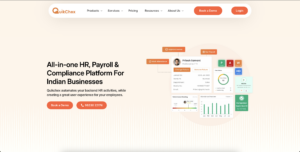
Quikchex is a comprehensive HRMS platform tailored for Indian businesses of all sizes. It centralizes HR, payroll, attendance, leave, recruitment, performance, compliance, and analytics into a single system. The solution automates payroll and statutory compliance meaningfully, reducing processing times drastically.
Pros All-in-one HR and payroll system
Strong Indian payroll and compliance automation (EPF/ESIC/TDS)
Mobile attendance tracking and GPS-based features
User-friendly interface and quick onboarding
Cons
✘ Due to the modular nature, final pricing may require contact to get a tailored plan
✘ Complex and highly customized requests require setup assistance
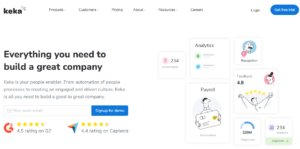
2. Keka — Premium Tool for Mid-Sized Teams
Overview
Keka offers payroll, HR, performance management, and applicant tracking in a unified dashboard. It’s known for smooth workflow automation and strong payroll processing suited for companies scaling their HR operations.
Pros
✔ Modern UI with a payroll engine
✔ Performance reviews and engagement tools
✔ Good mobile experience
Cons
✘ Pricing can be high for small to mid-sized teams
✘ Feature complexity is high and requires training
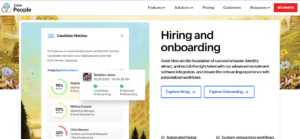
3. Zoho People — HR Module Part of an Ecosystem
Overview
Zoho People is a cloud-based HRMS within the Zoho ecosystem, offering HR database management, onboarding, workflow automation, leave and attendance tracking. It’s especially useful for businesses already using Zoho apps.
Pros
✔ Popular with high adoption
✔ Supports workflow automation
✔ Integration available but only with Zoho suite
Cons
✘ Requires Zoho Payroll add-on for payroll capabilities
✘ Setup and complex process configuration needs support from third-party vendors
✘ Minimal support from Zoho’s in-house team, premium support plan needed
4. GreytHR — Best for Businesses Needing Compliance-Centric Tools
Overview
GreytHR is a trusted HRMS with excellent payroll and statutory compliance support, perfect for small and medium teams focused on accurate reporting and adherence to Indian labour laws.
Pros
✔ Reliable payroll and compliance automation
✔ Easy attendance and leave tracking
✔ Legacy business
Cons
✘ UI feels dated compared to modern platforms
✘ Limited advanced HR features
5. Zimyo — Known for HR Automation
Overview
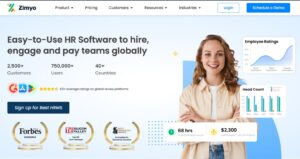
Zimyo offers an AI-powered HRMS covering payroll, attendance, performance, and employee engagement modules. Its cloud platform centralizes HR workflows and improves operational efficiency.
Pros
✔ Extensive automation + employee ESS portal
✔ Configurable workflows and dashboards
✔ Mobile accessible
Cons
✘ Some advanced setup required
✘ Support experience can vary
6. factoHR — Best For Only Core HR Features
Overview
factoHR focuses on giving SMEs a simple yet powerful HRMS with core HR, payroll, attendance, and compliance modules — widely used across Indian businesses with field teams.
Pros
✔ Strong core HR and payroll features
✔ Easy to implement
Cons
✘ UI can feel less modern
✘ Less powerful analytics
7. HROne — Best forSmall Businesses/Startups(<25 Employees)
Overview
HROne simplifies HR operations with strong core HR, payroll, recruitment, and performance modules — often favored by companies that want an intuitive workflow similar to an email-style HR inbox.
Pros
✔ Easy to use for HR teams
✔ Good attendance and recruitment modules
Cons
✘ Custom pricing only
✘ Steeper learning curve
8. Darwinbox — Best for Multi-national Enterprises
Overview
Darwinbox is an enterprise-grade HRMS with advanced analytics, AI insights, and mobile-first user experience for complex organizations.
Pros
✔ Scalable with deep automation
✔ Advanced workforce insights
Cons
✘ Higher cost and complex implementation
✘ Performance slowdowns may occur when handling large data volumes or complex reports
9. ZingHR — Best for Legacy Businesses
Overview
ZingHR offers comprehensive HR modules with strong performance, workforce, and compliance tools — ideal for companies spread across different locations.
Pros
✔ Wide range of HR features
✔ Strong performance and engagement tools
Cons
✘ Complex setup process
✘ Some users report UI challenges
10. Pocket HRMS — Best forSmall Businesses/Startups (<25 Employees)
Overview
Pocket HRMS provides core HR, payroll, attendance, and employee self-service features with AI-driven tools like chatbots for SME teams seeking simple solutions.
Pros
✔ AI chatbot and automation
✔ Affordable pricing
Cons
✘ Less scalable for large enterprises
✘ UI may feel outdated to some users
Conclusion
Choosing the proper HRMS in 2026 will help your HR function go from an administrative burden to a strategic strength. Quikchex leads the pack with a well-balanced blend of automation, compliance, payroll, and HR workflows, making it the best option for organizations looking for both efficiency and compliance in India.
Exhaustive Checklist for Evaluating HRMS Platforms & Services
Use this checklist to objectively compare HRMS vendors. It helps businesses evaluate HR software across functionality, compliance, integrations, implementation, and long‑term scalability.
Core HR & Employee Data
- Centralized employee database
- Custom employee fields and organization charts
- Role-based access controls
- Multi-company or multi-entity support
Payroll & Compliance
- Automated payroll processing
- PF, ESIC, PT, TDS statutory calculations
- Form 16, Form 24 and ECR generation
- Flexible salary structures and variable pay support
Attendance & Time Tracking
- Biometric and mobile attendance integrations
- Geo-tagged mobile check-in
- Shift and roster management
- Automatic overtime and leave calculations
Recruitment & Onboarding
- Built-in applicant tracking system (ATS)
- Automated Offer letter generation
- Automated onboarding workflows
- Background verification integrations
Performance & Learning
- Goal setting and OKR tracking
- Performance reviews and appraisal cycles
- 360-degree feedback capabilities
- Learning and training management integrations
Employee Self-Service (ESS)
- Employee portal for payslips and tax declarations
- Mobile app access for HR tasks
- Leave and attendance requests
- Expense claims and reimbursements
Analytics & Reporting
- HR dashboards and workforce insights
- Custom report builder
- Attrition and workforce analytics
- Exportable reports for finance and management
Integrations
- Accounting software integrations
- Attendance system integrations
- Open APIs for custom integrations
- SSO support for enterprise security
Security & Data Protection
- Data encryption and secure storage
- Role-based permissions
- Compliance with security standards
- Audit logs and data access tracking
Implementation & Support
- Dedicated implementation team
- Data migration support
- Employee and admin training
- Reliable customer support
Pricing & Scalability
- Transparent pricing structure
- Flexible plans for growing teams
- No hidden costs for essential modules
- Ability to scale with company growth
Click here to download a print-ready checklist.
FAQs
1. What is HRMS software?
HRMS (Human Resource Management System) software is a digital tool that lets businesses handle all of their HR tasks, like payroll, attendance, employee data, leave management, hiring, and compliance, from a single location.
2. Why do companies use HRMS software?
Companies use HRMS software to automate repetitive HR tasks, cut down on payroll mistakes, make sure they follow labor laws, and keep track of employee data in an efficient way.
3. What features should a good HRMS software include?
A good HRMS software typically includes:
- Payroll management
- Attendance and leave tracking
- Employee database
- Performance management
- Employee self-service portal
- Compliance management
- HR analytics and reporting.
4. Is HRMS software necessary for small businesses?
Yes. HRMS software is good for small businesses because it cuts down on manual HR work, makes payroll more accurate, and helps keep track of employee records as the business grows.
5. What is the difference between HRMS and HRIS?
While HRMS is more sophisticated and includes payroll, performance management, analytics, and automation tools, HRIS primarily concentrates on storing employee data and fundamental HR procedures.
6. How does HRMS software help with payroll?
HRMS software automatically calculates salaries, taxes, bonuses, and deductions based on attendance and policies, reducing errors, and ensuring timely payroll processing.
7. Can HRMS software help with compliance in India?
Yes. Many HRMS platforms assist businesses in avoiding fines and maintaining compliance with Indian labor laws by supporting statutory compliance, including PF, ESIC, TDS, and professional tax.
8. What is an employee self-service portal in HRMS?
An employee self-service (ESS) portal allows employees to access payslips, apply for leave, check attendance, and update personal information without contacting HR.
9. How much does HRMS software cost in India?
Depending on features, modules, and business size, HRMS software in India usually costs between ₹20 and ₹150 per employee per month.
10. Which HRMS software is best for payroll and compliance management in India?
HRMS solutions created especially for Indian regulations are frequently preferred by companies that need robust payroll automation and support for statutory compliance. Platforms such as Quikchex help businesses lower compliance risks by offering integrated payroll processing and compliance management for PF, ESIC, TDS, and other legal requirements.
11. Can HRMS software improve employee experience?
Yes, self-service portals, quicker HR procedures, and better employee-HR team communication are all ways that HRMS tools promote transparency and improve employee experience.
12. Is HRMS software secure for storing employee data?
Most modern HRMS platforms, such as Quikchex, use secure cloud infrastructure, encryption, and role-based access controls to protect employee data and company information. You also need to make sure to check if your HRMS software provider in India has SOC 2 Type 2 & ISO/IEC 27001:2022 certified.
You can visit our Trust Centre to see how Quikchex is compliant and keeps customer data safe and secure.
Important Note: If you are an Indian business, you need to make sure your data is stored within India.
13. What are the benefits of cloud-based HRMS software?
Cloud HRMS solutions offer:
- Remote access from anywhere
- Automatic updates
- Lower IT maintenance costs
- Real-time workforce data and reports.
14. Can HRMS integrate with other business tools?
Yes. Many HRMS systems integrate with:
- Accounting software
- Biometric attendance systems
- Recruitment tools
- Banking systems for payroll processing.
15. Is HRMS software scalable for growing businesses?
Yes. The majority of cloud-based HRMS systems are scalable and may help companies expand from small teams to massive corporations. Solutions like Quikchex offer modular features that can adapt to increasing employee numbers and more complex HR requirements.